 >
> 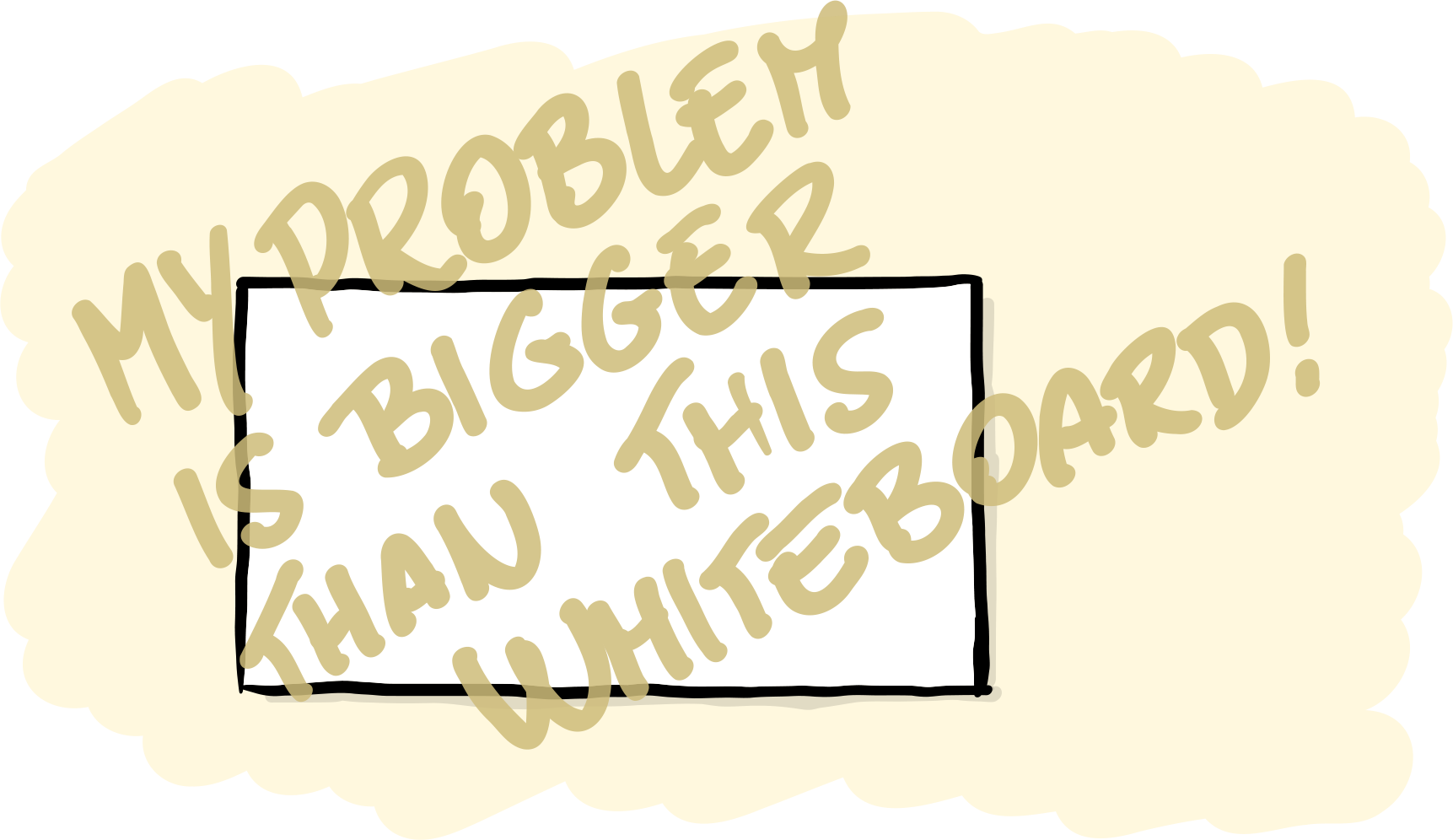
Most meeting room settings offer only limited space for modelling activities. When whiteboards are available, they are still limited in size and sometimes cluttered with old diagrams that nobody dares to erase.
When modelling in a limited space, our brain adds an extra constraint in the background: "We need to draw a solution to this complex problem," and "The solution needs to fit into the limited available space."
Funnily, adding an extra constraint is often an unconscious process: people are only aware that the problem is getting more complicated, but can't easily explain the reason.
Modelling space is not the only resource that can affect our thinking. When sticky notes are perceived as scarce, people tend to write only the essential things (often hiding critical details). Scarcity affects behaviour.
Other times, limitations in the available space or time force people to focus on a specific area prematurely, denying the possibility of a systemic view.
Provide the illusion of an infinite modelling surface: the paper roll is larger than any whiteboard you have ever used before, there are enough markers and stickies to run 3-4 workshops, and in no way should there be any reason to think, "There is not enough of that" .
Time is the only real constraint, but to deliver on time, we must ensure that we are just modelling the problem and nothing else.
Modelling on infinite boards online
Online modelling tools are often built on the paradigm of an infinite board, showing that our paper roll can be transformed into a huge modelling surface, albeit not yet infinite. However, when boundaries are missing, it's our responsibility to provide some. Online workshops often start in a frame , which is a bounded portion of an unbounded modelling surface.
Providing sample stickies and their expected size helps frame the modelling activity, but be ready to resize your frames, stickies, or both.
The most exciting feature of an infinite digital board is the possibility to share different types of information on the same surface: different versions of the same exploration, a linked drill-down exploration on a portion of the main flow, a different modelling technique, like User Story Mapping, Business Model Canvas, or Wardley Mapping, along with some journaling texts that explain the evolution between different versions of the model.